What the words in a listing mean
Check the material of the tabletop separately from the legs and frame. These are the terms you are most likely to see:
- Solid oak. The top is oak all the way through. It may be made from several boards joined together, but every board is solid timber.
- Oak veneer. A thin sheet of real oak glued onto a core board, usually MDF or particleboard. The surface is real oak; the core is a different material.
- Oak effect or oak finish. Usually a printed or coloured surface made to look like oak. There may be no oak in it at all.
- Engineered, or “solid wood”. These terms need clarification. Engineered wood can include layered construction; solid wood describes timber but does not identify the species.
- Solid oak legs or frame. This describes the legs or frame, so check the top separately.
A top made from narrow strips of oak is still solid oak if the boards are solid throughout. Narrow boards create more visible joins; wider boards show larger areas of grain. Board count alone does not determine quality.
Five ways to check a table
1. Look at the end of the top
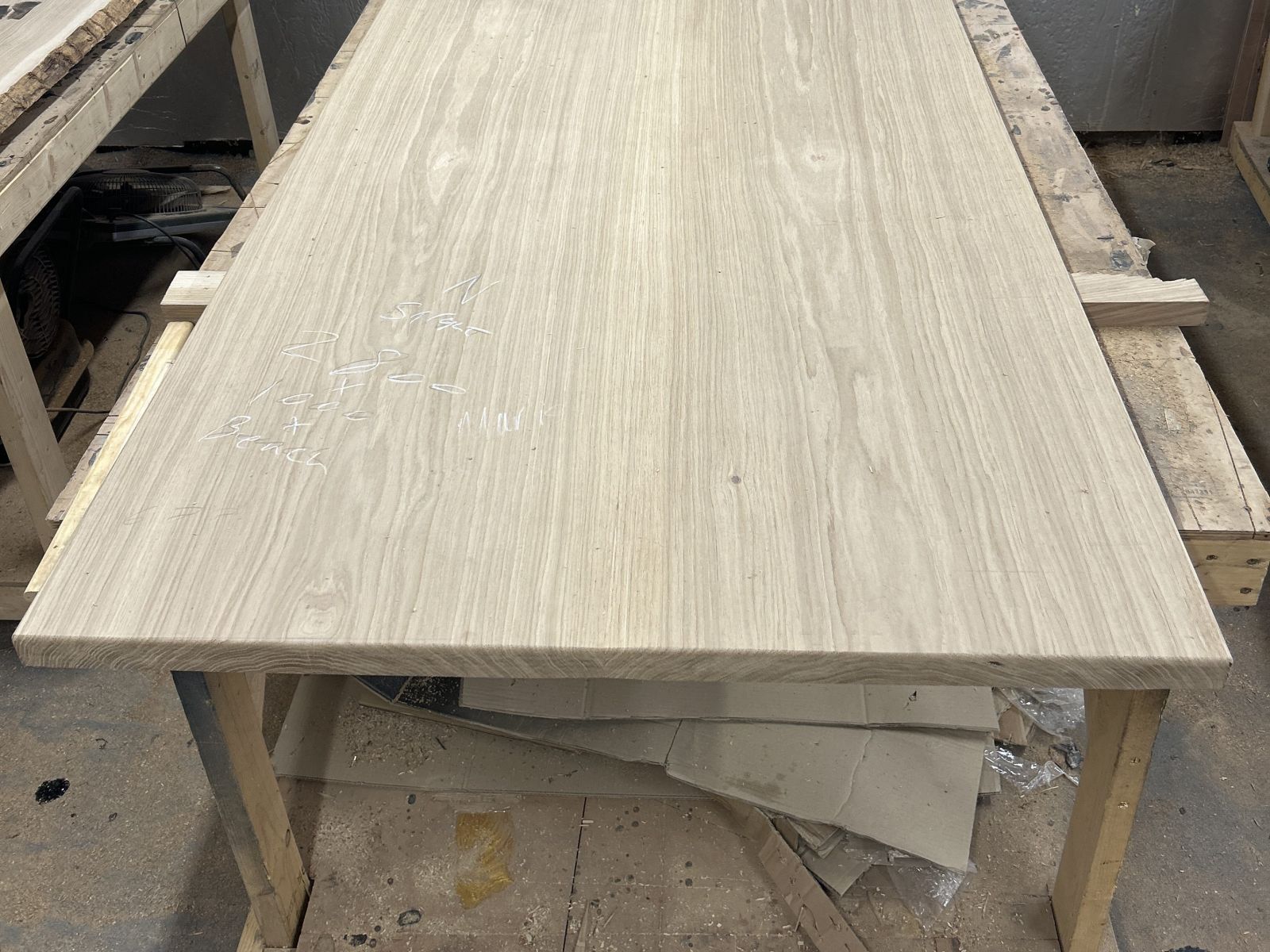
Visible end grain can help identify solid oak. Look for grain through the thickness of the board. Edging can hide the core of a veneered top, so ask the seller to confirm the construction if the end is covered.
2. Follow the grain over the edge
On solid oak, the grain usually continues from the surface into the side of the board. A separate strip of edging may have a different grain pattern. Use this as a clue alongside the product specification.
3. Check the thickness in the middle, not just at the edge
Some tops are a thin board with a deeper strip glued around the outside, so the table looks substantial from the side. Look underneath, or ask for the thickness of the board itself, not the edge.
4. Look underneath
Check the underside for exposed board edges, edging or a core material. Some veneered tops have real oak on both faces, so a similar-looking underside does not prove the top is solid.
5. Feel the weight
Our solid oak tops weigh roughly 30kg at 120 × 90cm and up to about 92kg at 280 × 120cm. Weight alone is not a reliable test: a veneered top with a dense core can also be heavy. Confirm the material in the specification.
Buying online? Ask the seller for a close-up photo of the end of the top and a photo of the underside. A maker building in solid wood will be happy to send both.
Why it matters over the years
Both materials have advantages. Oak veneer can offer a stable surface at a lower price, while solid oak allows more scope for sanding and refinishing. Veneer has a thin surface layer that limits how much material can be removed. Some marks on either surface can be repaired, depending on the finish and the depth of the damage.
The finish affects care and repair as well as the timber underneath. Our hardwax-oiled tops can be refreshed when the surface needs it. Check our wood care guide before sanding or re-oiling, particularly if your table has a coloured finish.
How a Timber Row top is made
Every Timber Row top is 37mm of solid French oak, with no veneer, MDF or hollow core. Our rectangular tops use two wide, matched slabs; the 140 and 150cm square tops use three boards. This construction keeps the number of joins low and shows the grain across broader boards.
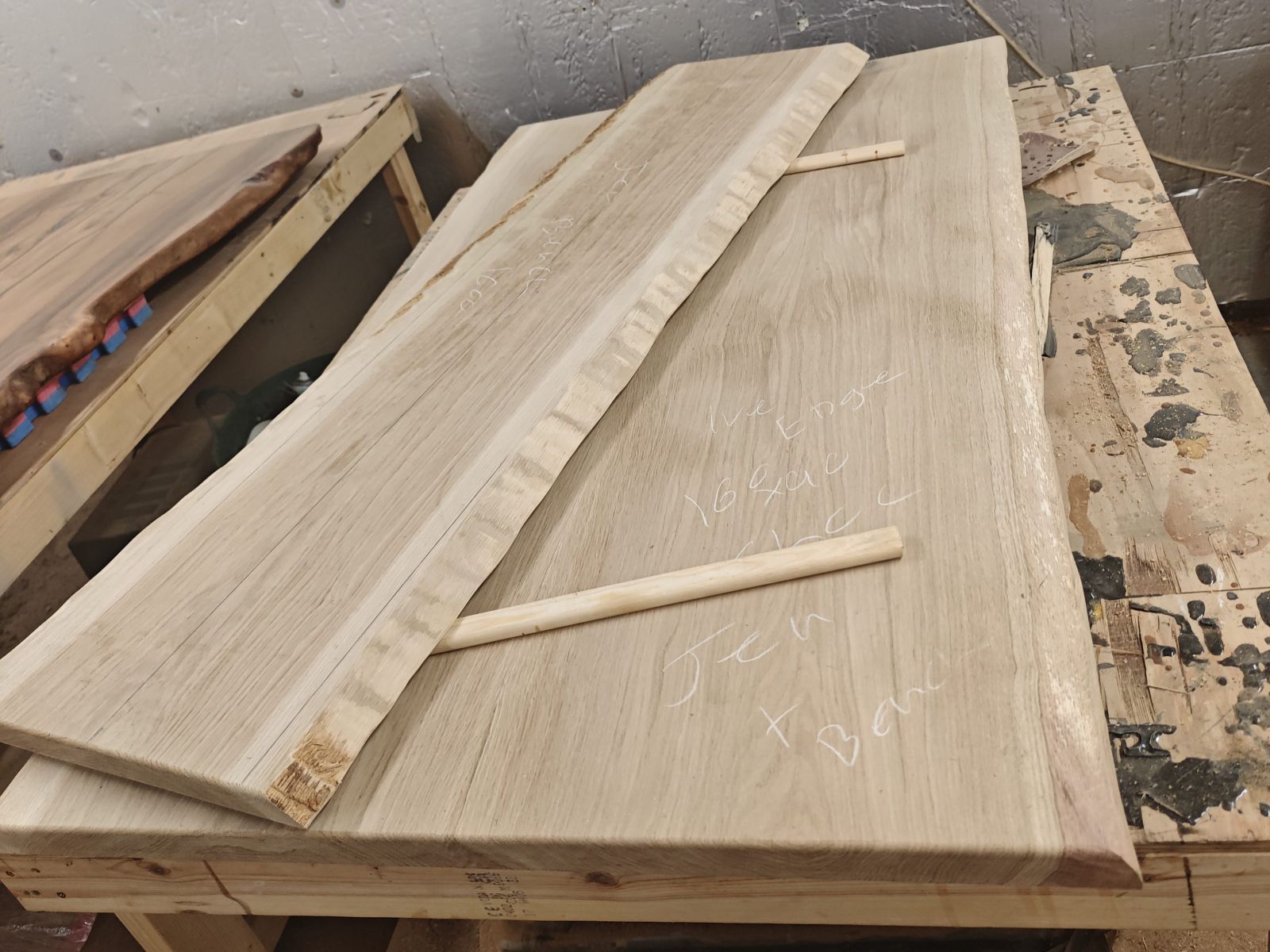
- Matched slabs. We choose two wide boards that match in grain and colour and machine their joining edges dead straight.
- Glued and domino-jointed. Hardwood domino tenons are set into both edges along the full length, then the joint is glued and clamped, to form a secure joint.
- Sanded at full thickness. The top is sanded flat by hand at its full 37mm, then finished with two coats of hardwax oil.
- Held flat, free to move. Slotted steel C-channel bars underneath let the oak move with the seasons while holding it flat against warping and cupping.
The edge shows the full 37mm thickness of oak. We match the boards for grain and colour, though the join remains part of the top’s natural appearance. A worn surface can be sanded and re-oiled when appropriate. We also offer a paid workshop refresh service from five years after delivery.
What real oak looks like
Oak varies naturally in grain and colour. Our tops may show knots, medullary rays (fine silvery flecks) and small natural fissures. These features differ from board to board, and the colour changes gradually with age and exposure to light.
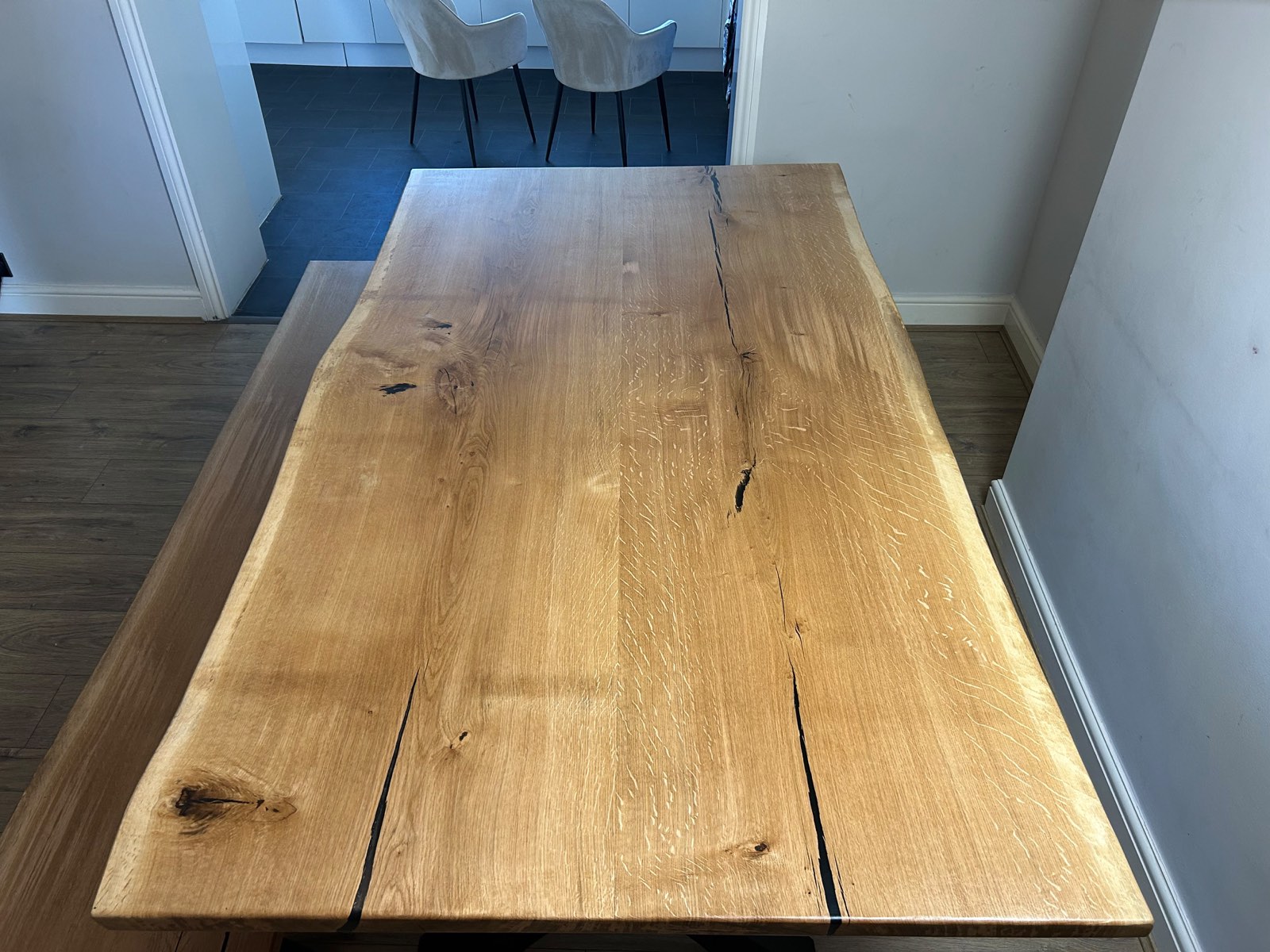
Real oak veneer also has natural grain and variation. Repeating patterns may indicate a printed oak-effect surface, but appearance alone cannot confirm the construction. Check the specification and ask the seller if it is unclear.
Common questions
How thick should a solid oak dining table top be?
There’s no single right number, but check that the thickness quoted is the whole board and not just the edge. Some tops are a thin board with a deeper strip glued around the edge to look chunky. Every Timber Row top is 37mm of solid French oak, edge to edge and top to bottom.
Can a veneered table be sanded and refinished?
Sometimes, but the thin oak layer limits sanding. Sanding through it exposes the core. Check the veneer thickness and finish before attempting a repair. Solid oak usually gives more scope for sanding and refinishing.
Is a top made from several boards still solid oak?
Yes, as long as every board is solid timber through its full thickness. Almost all solid tops are made from more than one board. What differs is how many boards there are and how they’re joined. Our rectangular tops use two wide slabs, glued and domino-jointed. The 140 and 150cm square tops use three boards.
Do solid oak tables crack?
Solid wood takes in and releases moisture as the seasons change, so small checks or hairline cracks can appear and existing natural fissures can open or close slightly. That’s normal for real timber. Splitting or distortion caused by a fault in how the table was made is covered by our 10-year structural guarantee.
Next: see how size, edge, legs and finish fit together in our guide to buying a solid oak dining table.